For many Small and Medium Businesses (SMBs) across North Dakota, South Dakota, and Minnesota, IT is often judged by one simple standard:
Is everything working today?
The computers turn on. Email works. Employees can access their files. The internet is running. When someone has a problem, they call IT and get help.
That is an important part of managed IT services. But it is only part of what a strong technology partnership should provide.
The bigger question is:
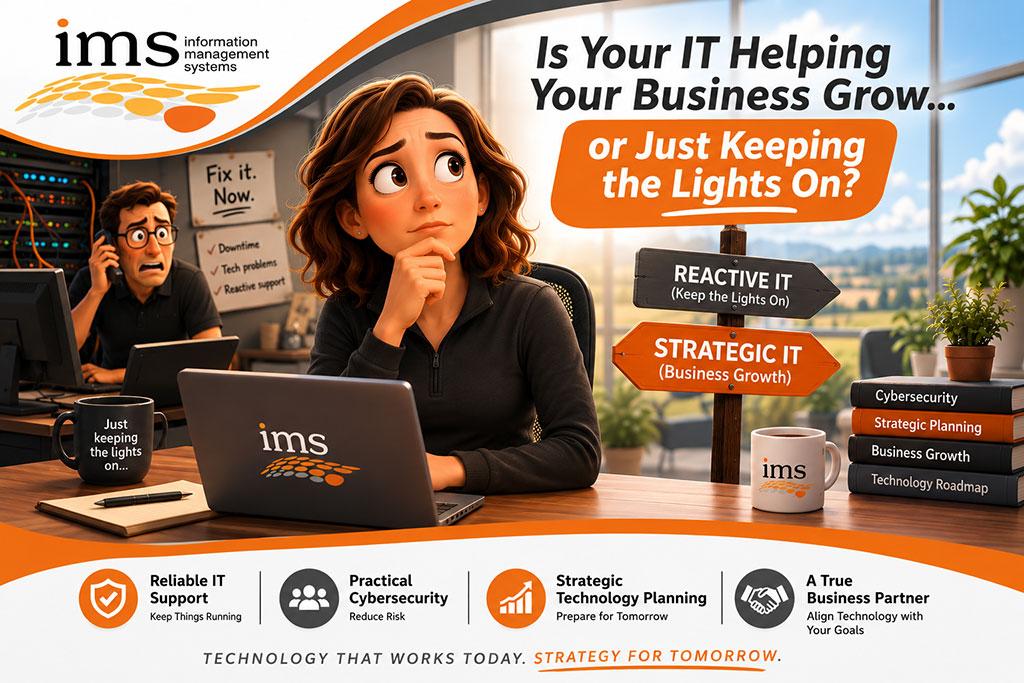
Is your IT provider simply keeping your technology running, or are they also helping make sure your technology is taking your business in the right direction?
That is where strategic IT comes in.
Managed IT keeps your technology running. Strategic IT helps make sure your technology is taking your business in the right direction.
The two are not competing approaches. In fact, the best technology partnerships combine both.
At Information Management Systems (IMS), we believe Small and Medium Businesses need responsive day-to-day IT support along with proactive technology management, practical cybersecurity, and strategic planning that connects technology decisions to business goals.
What Is Managed IT?
Managed IT services provide ongoing management and support for a business's technology.
Instead of waiting until something breaks and then searching for someone to fix it, a Managed Service Provider (MSP) takes ongoing responsibility for supporting and managing agreed-upon areas of the technology environment.
For an SMB, managed IT services can include:
- Day-to-day IT support
- User onboarding and offboarding
- Microsoft 365 administration
- Network management
- Cybersecurity management
- Backup and recovery
- Server and infrastructure management
- Technology monitoring
- Vendor coordination
- Technology maintenance
The exact services vary depending on the provider and the needs of the business.
At its core, managed IT answers an important question:
Who is responsible for keeping our technology working, supported, and managed?
But there is another question business leaders should ask:
Who is helping us decide what our technology should look like next year, three years from now, or as our business changes?
That is the strategic side of IT.
What Is Strategic IT?
Strategic IT is not a replacement for managed IT services.
It is the planning and business-focused layer that makes managed IT more valuable.
Strategic IT connects technology decisions to the organization's business goals, risks, growth plans, budget, employees, and future needs.
Instead of only asking:
"What technology problem needs to be fixed?"
A strategic IT partner also asks:
"What does this business need from technology next?"
That could mean planning for:
- Business growth
- New employees
- New locations
- Aging computers or servers
- Cybersecurity improvements
- Cyber insurance requirements
- Microsoft 365 improvements
- Network upgrades
- Backup and recovery needs
- New business applications
- Remote or hybrid employees
- Technology budgeting
- Vendor changes
- Business continuity
For Small and Medium Businesses, strategic IT does not need to mean a complicated technology plan filled with technical jargon.
It should be practical.
It should help leadership understand where the business is today, where it is going, what technology risks or limitations exist, and what should be addressed next.
Can an MSP Provide Strategic IT?
Yes. An MSP can provide strategic IT services, but simply being an MSP does not automatically mean the provider takes a strategic approach.
Some IT relationships remain heavily focused on support tickets, maintenance, and keeping existing systems operational.
Those services matter. Businesses need reliable technology and responsive support.
But a strong MSP relationship should go further.
Your provider should also understand your business well enough to help you make informed decisions about technology.
For example, imagine your business has a server approaching the end of its useful life.
A managed IT provider should be able to maintain and support that server.
A strategic IT partner should also be talking with you about what comes next.
- Should it be replaced?
- Should the workload move somewhere else?
- What will the project cost?
- When should it happen?
- What happens to the business if the server fails before then?
- How should the expense fit into next year's budget?
The difference is not managed IT versus strategic IT.
The difference is whether your managed IT relationship includes enough strategic planning to help your business prepare instead of continually react.
Why Reactive IT Is Still a Problem
Even businesses that have an IT provider can find themselves operating reactively.
The issue is not necessarily whether you have an MSP.
The issue is whether most technology decisions happen before or after they become urgent.
Consider two businesses.
Business A has aging technology, but nobody has created a replacement plan. Everything continues working until one day a critical system fails. Leadership now has to make an important technology decision quickly, under pressure.
Business B has the same aging technology. Its IT provider identified the lifecycle concern in advance, discussed the business impact with leadership, presented options, and helped establish a reasonable timeline and budget.
Both businesses have IT support.
Only one is managing technology strategically.
7 Signs Your Managed IT Relationship May Be Missing the Strategic Piece
- You Only Talk to Your IT Provider When Something Goes Wrong
Responsive support is important, but your relationship should not revolve entirely around support tickets.Your IT provider should also have conversations with leadership when everything is working.
Those conversations help identify changing business needs, upcoming technology decisions, risks, and opportunities.
- You Do Not Have a Technology Roadmap
Businesses plan for vehicles, equipment, facilities, staffing, and other major investments.Technology deserves the same attention.
A technology roadmap can help leadership anticipate replacements, upgrades, cybersecurity initiatives, infrastructure projects, and other expenses before they become urgent.
- The Same Technology Problems Keep Coming Back
Resolving a support ticket fixes the immediate problem.Strategic IT asks whether the underlying issue should be addressed.
If employees continually experience the same problems, your provider should be looking for patterns and recommending longer-term improvements where appropriate.
- Nobody Can Clearly Explain Your Cybersecurity Strategy
Cybersecurity should not simply be a collection of products running behind the scenes.Business leadership should understand, at an appropriate level, how the organization is working to reduce risk, protect accounts and devices, secure email, protect data, and prepare for potential disruptions.
No cybersecurity provider or technology can eliminate every threat. The goal is to reduce risk and improve your organization's ability to respond and recover.
- Technology Purchases Feel Random
Buying computers, software, networking equipment, and cloud services one problem at a time can create unnecessary complexity.Strategic planning helps businesses establish standards and make technology decisions with the larger environment in mind.
- Your IT Provider Understands Your Technology, but Not Your Business
This is an important distinction.Your provider may know your servers, computers, firewall, and Microsoft 365 environment extremely well.
But do they understand how your company makes money?
Do they understand which applications are critical to operations?
Do they know when your busy season occurs?
Do they understand your growth plans?
Do they know which technology problems create the biggest operational impact?
Technology recommendations become more valuable when your IT provider understands the business behind the technology.
- IT Expenses Continually Surprise You
Not every technology expense can be predicted.Many can.
Lifecycle planning, licensing reviews, infrastructure planning, cybersecurity discussions, and regular technology reviews can help leadership anticipate future investments and incorporate them into the business's budget.
Why Strategic IT Matters for SMBs in ND, SD, and MN
Small and Medium Businesses across North Dakota, South Dakota, and Minnesota often run lean.
Employees wear multiple hats. Leadership teams are busy. Technology decisions may compete with investments in people, vehicles, equipment, facilities, inventory, and growth.
That makes planning even more important.
When technology is managed strategically, business leaders can make decisions on their timeline instead of waiting for technology to force the issue.
- A network upgrade can be planned before capacity becomes a problem.
- Computers can be replaced according to a lifecycle instead of waiting for employees to become frustrated.
- Cybersecurity improvements can be prioritized based on risk.
- Backup and recovery expectations can be discussed before a disruption.
- Technology expenses can be incorporated into budgets.
- Growth plans can include the technology required to support them.
For an SMB, that is what strategic IT should accomplish.
Managed IT Should Support Today's Business and Tomorrow's Plans
One of the most valuable conversations you can have with your IT provider may have nothing to do with a support ticket.
It may start with questions such as:
- Where is your business going?
- Are you hiring?
- Opening another location?
- Adding remote employees?
- Replacing a critical application?
- Planning a major equipment purchase?
- Facing new cyber insurance requirements?
- Concerned about cybersecurity?
- Dealing with aging infrastructure?
- Trying to improve collaboration?
- Building next year's budget?
These business decisions often have technology implications.
Your MSP should understand those implications and help you plan accordingly.
At IMS, this is why Strategic Technology Reviews are an important part of our approach. Depending on the client, these reviews can occur at least annually and up to quarterly. They help connect technology recommendations to business impact, security risk, supportability, lifecycle status, employee productivity, backup and recovery, Microsoft 365 maturity, network health, budget priorities, and recommended timelines.
What Should You Expect From a Strategic Managed IT Provider?
A strong managed IT relationship should help your business with both sides of technology.
Operationally, your MSP should help keep technology reliable, secure, supported, and properly managed.
Strategically, your MSP should help leadership understand what needs attention, why it matters, when it should happen, and how it connects to the business.
That can include helping you:
- Support employees when they need assistance
- Maintain day-to-day technology reliability
- Manage Microsoft 365 and other critical services
- Identify aging or unsupported technology
- Reduce cybersecurity risk
- Review backup and recovery capabilities
- Maintain networks and infrastructure
- Coordinate with third-party technology vendors
- Identify upcoming technology investments
- Establish technology priorities
- Plan technology budgets
- Connect recommendations to business goals
- Regularly review the health and direction of your technology environment
The objective is not to convince your business to buy more technology.
The objective is to help your business make better technology decisions.
Is Your IT Keeping You Running or Helping You Move Forward?
There will always be a need for day-to-day IT support.
Employees will forget passwords. Computers will have problems. Software will stop cooperating. Vendors will point fingers. Networks will occasionally need troubleshooting.
You want an IT partner who will be there when those things happen.
But that should not be the entire relationship.
A strong MSP should help you operate effectively today while also helping you prepare for tomorrow.
That is the combination businesses should be looking for:
Responsive managed IT support for today's needs, combined with strategic technology guidance for what's next.
Managed IT and Strategic Technology Guidance for SMBs in ND, SD, and MN
Information Management Systems helps Small and Medium Businesses across the Red River Valley and surrounding areas of North Dakota, South Dakota, and Minnesota keep technology reliable, secure, and aligned with their business goals.
We combine responsive IT support, practical cybersecurity, strategic technology reviews, and hands-on vendor coordination to help our clients spend less time chasing technology problems and more time running their businesses.
If you are evaluating your current IT relationship, ask yourself two questions:
Does our IT provider help keep our technology running?
And:
Are they helping make sure our technology is taking our business in the right direction?
A strong technology partnership should do both.
Frequently Asked Questions
Is strategic IT the same as managed IT services?
No. Managed IT services provide ongoing technology management and support, while strategic IT focuses on aligning technology decisions with business goals, risks, budgets, and future plans.
A strong Managed Service Provider can combine both by supporting day-to-day technology while also helping leadership plan for future technology needs.
What is a Managed Service Provider (MSP)?
A Managed Service Provider, or MSP, is a company that provides ongoing management and support for a business's technology.
Depending on the provider and service agreement, this can include IT support, Microsoft 365 administration, cybersecurity, networking, backups, infrastructure management, monitoring, and vendor coordination.
Why should an SMB choose an MSP that provides strategic technology planning?
Small and Medium Businesses can benefit from an MSP that provides both responsive support and strategic planning.
This approach helps leadership anticipate technology expenses, identify risks, plan upgrades, prepare for growth, and connect technology investments to business priorities instead of making every decision reactively.
What should SMBs in North Dakota, South Dakota, and Minnesota look for in an MSP?
SMBs in North Dakota, South Dakota, and Minnesota should look for an MSP that provides responsive support, understands the business behind the technology, proactively manages critical systems, takes cybersecurity seriously, helps coordinate vendors, and provides regular strategic technology guidance.
A local or regional provider can also offer valuable familiarity with the businesses and communities it serves.
How often should my MSP review our technology strategy?
Businesses should generally review their technology strategy at least annually.
Growing businesses or organizations experiencing significant technology, cybersecurity, staffing, or operational changes may benefit from more frequent reviews.
IMS conducts Strategic Technology Reviews at least annually and, depending on client needs, up to quarterly.