 Written by: Kelsey Beauchamp
AI Is Starting to Act, Not Just Answer
Artificial intelligence is quickly becoming part of everyday business.
Employees are using AI to draft emails, summarize documents, research questions, analyze information, and save time on repetitive work. Now AI is moving into another phase with the growth of AI agents.
Unlike traditional AI tools that primarily respond to questions, AI agents can potentially interact with applications, access business information, complete workflows, and take actions on behalf of users.
For small and midsized businesses, that creates significant opportunities for productivity and automation. It also creates an important security and management question:
If AI can act on behalf of your employees, what should it be allowed to access and do?
The answer starts with understanding AI access, permissions, data security, and governance.
What Is an AI Agent?
An AI agent is an AI-powered system that can perform tasks or take actions toward a goal, sometimes across multiple applications or business systems.
Traditional AI generally waits for a user to ask a question and then provides a response.
An AI agent can potentially go further. Depending on the system and how it is configured, an agent might retrieve information, interact with applications, complete several steps in a workflow, or perform actions using permissions it has been given.
For example, an AI assistant might help an employee write an email.
An AI agent could potentially gather information from business systems, prepare the email, determine who should receive it, and initiate the next step in the workflow.
That additional capability is what makes AI agents so promising. It is also why businesses need to think carefully about security.
Why Do AI Agents Create New Cybersecurity Risks?
AI agents can create additional cybersecurity risk because they may have access to business data, applications, accounts, and the ability to perform actions.
The issue is not necessarily AI itself.
The issue is what the AI has permission to do.
If an AI agent has unnecessary access to sensitive files, customer information, email, financial systems, or other business applications, a mistake or compromised account could have a greater impact.
This makes identity and access management increasingly important.
Before connecting an AI tool or agent to business systems, organizations should understand:
- What information can the AI access?
- Which applications can it interact with?
- What actions can it perform?
- Does it have more permission than necessary?
- Which employee or process is it acting on behalf of?
- Can its activity be monitored?
- Which actions require human approval?
- Who is responsible for reviewing its access?
- What happens when the AI tool or integration is no longer needed?
These are not simply technical questions. They are business risk questions.
Identity and Access Matter More Than Ever
For years, businesses have worked to improve how employees access technology.
Good security practices include individual accounts, multifactor authentication, appropriate permissions, secure devices, and promptly removing access when someone leaves the organization.
Those principles become even more important as AI begins interacting with business systems.
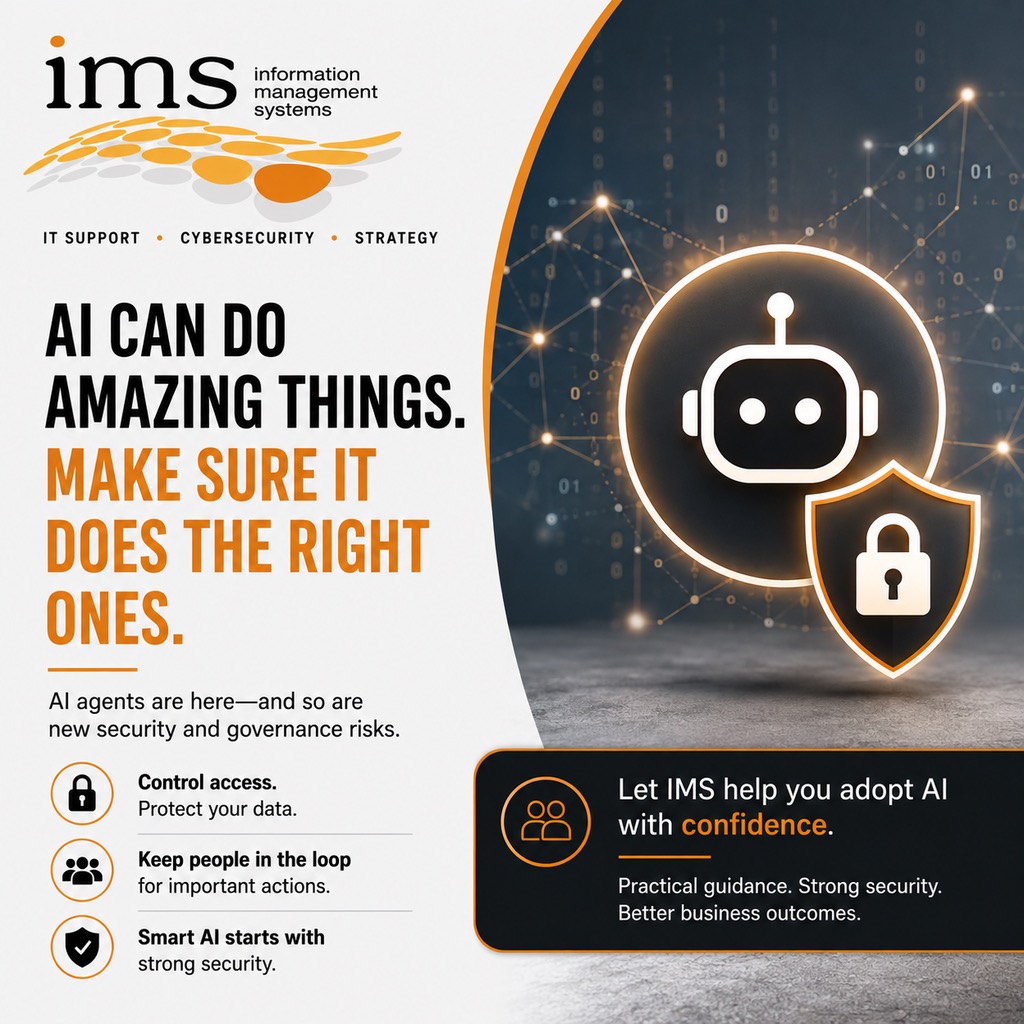
An AI agent should generally have access only to the information and systems required to perform its intended job.
That follows a well-established cybersecurity principle known as least privilege.
If an AI tool only needs access to a particular set of documents, giving it access to an entire organization's files may create unnecessary risk.
The same concept applies to email, cloud applications, customer information, financial systems, and other business resources.
What Is Shadow AI?
Shadow AI is the use of AI tools or services within a business without formal approval, visibility, or oversight from the organization.
It is becoming the AI version of a familiar IT problem.
Employees discover a tool that makes their job easier, create an account, and start using it. Their intentions may be completely reasonable. They are simply trying to get their work done faster.
The business, however, may not know:
- Which AI services employees are using
- What company information is being entered
- Where that information is stored
- Which applications have been connected
- What permissions have been granted
- Whether accounts are properly secured
- Whether access is removed when employees leave
The answer is not necessarily to prohibit AI.
A better approach is to give employees clear guidance about which tools are approved and how they can be used.
Does a Small Business Need an AI Policy?
Many small and midsized businesses can benefit from having a practical AI acceptable-use policy or AI governance guidelines.
It does not need to be a complicated document.
A useful starting point is establishing basic expectations around:
- Approved tools: Identify which AI applications employees are permitted to use for business purposes.
- Business information: Define what types of company, customer, employee, financial, confidential, or regulated information should not be provided to unapproved AI systems.
- Access: Determine which business applications and information approved AI systems can access.
- Human oversight: Establish when an employee should review an AI-generated recommendation or approve an AI-initiated action.
- Accountability: Make it clear that employees remain responsible for reviewing AI-generated work used for business purposes.
- Periodic review: Revisit approved AI tools and policies as their capabilities change.
The objective is not to make AI difficult to use. It is to establish reasonable boundaries so employees can benefit from the technology without creating unnecessary business risk.
AI Security Starts With Good Cybersecurity Fundamentals
AI may be changing rapidly, but the fundamentals of cybersecurity still matter.
In many cases, organizations that already have a well-managed technology environment are in a better position to evaluate and adopt AI responsibly.
Important foundations include:
- Strong identity and access management
- Multifactor authentication
- Appropriate user permissions
- Secure endpoint devices
- Email security
- Network security
- Security monitoring
- Reliable data backup and recovery
- Employee security awareness
- User onboarding and offboarding processes
- Regular technology and security reviews
AI does not replace these controls.
It makes getting them right even more important.
Cybersecurity is ultimately about managing risk. No AI system, security product, or IT provider can eliminate every threat. The goal is to reduce unnecessary exposure, improve visibility, and put the organization in a stronger position to respond when something goes wrong.
How Can Businesses Adopt AI More Safely?
Businesses can adopt AI more safely by starting with the business problem, evaluating data and access requirements, establishing appropriate controls, and keeping people involved in important decisions.
Before adopting an AI application or agent, ask:
- What problem are we trying to solve?
- AI should have a business purpose. Start with the outcome rather than adopting a tool simply because it is new.
- What information does the AI need?
- Determine what data is actually necessary for the tool to accomplish its purpose.
- What systems should it access?
- Avoid granting broad permissions simply because doing so is convenient.
- What could happen if it makes a mistake?
- The greater the potential business impact, the more important human review becomes.
- How will we know what it did?
- Organizations should consider whether important AI actions can be monitored, logged, or reviewed.
- Who is responsible for the system?
- Someone within the organization should understand why the AI is being used and periodically review whether its access remains appropriate.
This turns AI adoption into a deliberate business technology decision rather than an uncontrolled technology experiment.
AI Should Be Part of Your Technology Strategy
AI is unlikely to remain a separate category of technology.
Increasingly, AI capabilities are being incorporated into the applications and services businesses already use.
That means AI planning should become part of broader conversations about cybersecurity, employee productivity, data management, access control, business continuity, and technology strategy.
For business leaders, the question is shifting from:
"Should we use AI?"
to:
"Where does AI make sense for our business, and how do we use it responsibly?"
That is a much more useful conversation.
How IMS Helps Businesses Navigate AI and Technology
Information Management Systems helps businesses across the Red River Valley keep technology reliable, secure, and aligned with their business goals.
We combine responsive IT support, practical cybersecurity, strategic technology planning, and hands-on coordination to help clients stay focused on running their businesses instead of chasing technology problems.
As AI becomes a larger part of everyday business technology, we can help clients evaluate how new capabilities fit into their existing technology environment.
That includes looking at areas such as:
- Business objectives and potential AI use cases
- User accounts and access
- Microsoft 365 environments
- Security controls
- Business applications
- Data protection
- Employee technology practices
- Technology policies and governance
- Overall technology strategy
Our goal is not to overwhelm businesses with jargon or discourage useful technology.
It is to help clients understand their options, reduce unnecessary risk, and make better technology decisions with confidence.
Frequently Asked Questions About AI and Business Security
1. What is an AI agent?
An AI agent is an AI-powered system capable of performing tasks or taking actions toward a goal. Depending on how it is configured, an agent may interact with applications, retrieve business information, complete workflows, or take actions on behalf of a user.
Because AI agents can potentially access business systems rather than simply provide answers, organizations should carefully consider their permissions and security.
2. Are AI tools safe for employees to use at work?
AI tools can be useful for business, but they should be used with appropriate safeguards.
Businesses should establish which AI tools are approved, what types of information employees can provide to them, and which business systems those tools can access.
AI security should be treated as an ongoing risk-management process rather than a one-time technology decision.
3. What information should employees avoid putting into AI tools?
Employees should be cautious about entering sensitive or confidential information into AI services that have not been evaluated and approved for that type of business use.
Examples may include customer information, employee records, passwords or credentials, financial information, contracts, proprietary information, regulated data, or other confidential business information.
A clear AI policy can help employees understand what is appropriate instead of requiring them to make those decisions individually.
4. Does my business need an AI policy?
Many businesses can benefit from establishing basic AI usage guidelines.
An AI policy can identify approved tools, acceptable uses, expectations for handling sensitive information, requirements for human review, and when employees should involve management or IT.
Policies should also be reviewed periodically because AI tools and their capabilities are evolving rapidly.
5. How can IMS help our business adopt AI more securely?
IMS can help businesses evaluate AI as part of their broader technology strategy.
We can help clients look at how AI interacts with accounts, permissions, business applications, security controls, employee workflows, and existing technology practices. We can also help identify practical areas where AI may provide business value while discussing the security and operational considerations involved.
No technology strategy can eliminate every risk. Thoughtful planning, appropriate controls, and ongoing technology management can help businesses adopt AI with greater confidence.
Ready to Talk About AI in Your Business?
AI is moving quickly, and businesses do not need to have every answer today.
They do need a plan.
If your organization is already experimenting with AI, considering AI agents, or simply trying to understand what these technologies mean for your business, IMS can help you evaluate the technology from a practical business and security perspective.
Talk with Information Management Systems about your technology environment, cybersecurity, and how AI could fit into your business strategy.